

For many commercial and residential solar asset owners, checking the energy generation app is a daily routine. If the graph shows a green checkmark and a steady curve, you assume everything is running perfectly. However, this relies on a dangerous assumption: that a functioning system is a healthy system.
In reality, thousands of solar arrays operate in an underperforming, “sub-healthy” state every day. For a mid-sized 150kW commercial rooftop station, a seemingly minor 5% drop in efficiency can quietly bleed thousands of dollars annually. Because standard central inverters only report total system output, these marginal losses slip completely under the radar. This guide exposes the hidden mechanical and electrical faults draining your solar ROI and explains how a smart monitoring solar energy system unmasks them before they become expensive failures.
1. Bypass Diode Failure: The Silent 30% Power Drain
A standard solar module is divided into multiple cell strings protected by bypass diodes. If a section of the panel is shaded or damaged, the diode activates to redirect current around it, preventing the entire panel from shutting down.
-
The Hidden Fault: If a bypass diode fails and gets stuck in an open or short circuit, it permanently cuts out that entire string of cells. This drops the individual panel’s power output by 30% to 40%.
-
The Dashboard Blindspot: Because the remaining panels in the string continue to pass electricity to the central inverter, your main dashboard won’t trigger an error code. It simply registers as a slightly cloudy day.
2. Progressive Hot Spot Degradation
Hot spots occur when a localized area of a solar panel experiences high thermal stress, usually triggered by persistent bird droppings, accumulated leaves, or micro-cracks in the silicon.
-
The Damage Mechanism: The shaded or cracked cell acts as a resistor instead of a generator. It forcibly consumes the energy produced by surrounding cells and converts it into heat.
-
The Long-Term Cost: In its early stages, a hot spot only mildly dampens voltage output. Over several months, however, this intense heat permanently damages the protective backing sheet and solar cells, transforming a cleanable maintenance issue into an irreparable structural failure.
3. Micro-Cracks from Thermal Cycling
Solar panels expand and contract every day as the sun heats them and the night cools them down. This thermal cycling places immense physical stress on the wafer connections.
-
The Invisible Fractures: Micro-cracks are completely invisible to the naked eye and cannot be detected by standard visual inspections.
-
The Consequence: As these microscopic cracks widen due to wind vibration or thermal expansion, they isolate portions of the cell, driving up internal resistance and permanently lowering the panel’s overall current threshold.
4. Connector & Junction Box Contact Resistance
The DC wiring underneath a solar array is exposed to extreme humidity and temperature swings. Over time, quick-connect plugs (like MC4 connectors) can suffer from moisture ingress or loose locking mechanisms.
-
The Efficiency Thief: Minor corrosion increases electrical resistance at the junction point. This resistance causes a localized voltage drop, bleeding off generated watts as heat.
-
The Fire Hazard: High resistance in a DC circuit creates a massive arc-fault risk. Left unaddressed, a loose connector can melt the junction box and pose a severe fire hazard to commercial rooftops.
5. Non-Uniform PID (Potential Induced Degradation)
Potential Induced Degradation (PID) is an unwanted voltage leakage that occurs between the internal silicon cells and the grounded aluminum frame of the panel.
-
The Patchy Decay: PID rarely hits an entire array evenly. It typically attacks the panels closest to the negative pole of a string.
-
The Confusion: Because the degradation happens gradually over 12 to 24 months, standard monitoring platforms mistake the drop for natural weather variances or standard panel aging, masking a systemic circuit leakage.
6. Sub-String Mismatch Losses
A solar string is only as strong as its weakest panel. If a single panel is underperforming due to heavy localized soiling or specialized aging, it throttles the current of every other panel connected in that same series.
-
The Multiplier Effect: One panel running at 80% efficiency can bottleneck a string of 20 panels, pulling down the entire group’s performance far past the actual physical blockage area.
7. Inverter Component Drifting
Inverters use sensitive capacitors and internal switching components to optimize the Maximum Power Point Tracking (MPPT) voltage curve.
-
The Tracking Drift: As internal electronic components age, their calibration values drift. The inverter will continue to run without reporting a system crash, but it will continuously hunt for the wrong voltage peak, missing out on optimal power production windows.
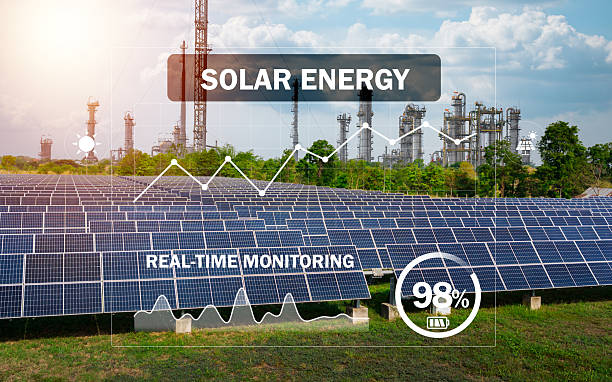
The Solution: Module-Level Diagnostic Infrastructure
Traditional “total-output” string monitoring is a reactive tool; it only tells you when the system has suffered a catastrophic failure. To catch the seven hidden faults outlined above, asset operators must pivot to a proactive smart monitoring solar energy system that leverages module-level data.
| Feature / Capability | Standard Inverter Dashboard | Smart Monitoring System (Huatao) |
| Data Granularity | Full Array / String Level Only | Individual Module Level ($1:1$) |
| Bypass Diode Fault Identification | Impossible (Registers as low light) | Instant Warning (Pinpoints exact panel) |
| Arc-Fault & Fire Mitigation | Post-incident reporting | Real-time circuit interruption |
| Aging / Degradation Analytics | Manual physical inspection required | Automated predictive health alerts |
By deploying intelligent rapid-shutdown devices, microinverters, or smart power optimizers at the back of each panel, your monitoring system gains the ability to isolate and evaluate every single piece of glass on your roof. When a bypass diode fails, or a hot spot begins to cook a cell, the software cross-references historical weather data, isolates the anomalous voltage curve, and sends an automated alert identifying the exact coordinates of the sub-healthy component.
Conclusion: Stop Guessing Your Energy Yield
A green light on your solar inverter does not mean your investment is working at its full potential.
Stop allowing hidden resistance, micro-cracks, and faulty diodes to quietly drain your commercial or residential power savings. By upgrading to a comprehensive smart monitoring solar energy system, you lift the veil on your array’s true performance metrics, securing every single watt of energy your property generates. Explore Huatao’s advanced monitoring and energy storage integration solutions today to safeguard your station’s long-term efficiency and operational safety.

Add comment