

A residential off-grid solar system can look very different depending on where it is installed and what the homeowner needs to power. A compact 1–3kW system on an apartment balcony is fundamentally different from a 3–10kW rooftop system or a 10–15kW ground-mounted system for a house with a yard.
The key is not simply choosing a larger solar array. An off-grid system must balance solar generation, battery storage, inverter capacity, available installation space, and household load patterns. Solar generation also changes throughout the day, while household demand can rise suddenly when appliances start.
For residential projects from 1kW to 15kW, the installation scenario provides a useful starting point: balcony systems for essential loads, rooftop systems for everyday household appliances, and ground-mounted systems for broader residential loads.
Residential Off-Grid Solar System: Three Typical Scenarios
The following framework can help homeowners and project developers compare the three common installation options.
| Installation scenario | Typical system range | Suitable property | Typical loads | Main design concern |
|---|---|---|---|---|
| Balcony | 1–3kW | Apartment or compact residence | Lighting, router, phones, small electronics | Limited space and load capacity |
| Rooftop | 3–10kW | Detached or larger home | Refrigerator, TV, fans, lighting, appliances | Roof condition, orientation and load profile |
| Yard/ground mount | 10–15kW | Home with available land | Basic whole-home loads and larger appliances | Land, battery environment and higher peak demand |
These ranges are planning categories rather than universal standards. Actual system sizing should be based on the site’s solar resource, usable installation area, energy consumption, desired autonomy, and appliance demand. DOE guidance similarly recommends evaluating energy demand and site-specific characteristics when determining PV system size.
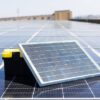
1–3kW Balcony Off-Grid Solar System
A 1–3kW residential off-grid solar system is generally the most space-conscious option in this comparison.
It can be relevant to apartment users, compact homes, small auxiliary spaces, or situations where only essential loads need backup power.
What Can a Balcony System Power?
The practical objective is usually essential-load coverage, rather than attempting to operate an entire apartment independently.
Typical loads may include:
- LED lighting
- Wi-Fi routers
- Smartphones and tablets
- Laptop computers
- Small electronics
- Communication equipment
- Selected low-power appliances
A properly designed battery system can store solar energy for use when sunlight is unavailable. Energy storage is particularly important for off-grid operation because PV generation does not necessarily coincide with the time electricity is needed.
Microinverter or Small Off-Grid Inverter?
Microinverters are widely used in PV systems because they convert the DC output of individual modules into AC and can provide independent module-level operation.
However, a true off-grid residential system also needs to be designed around battery storage and an inverter architecture capable of maintaining the required standalone AC supply.
Therefore, buyers should not select an inverter simply because its nominal power matches the PV array.
The more important questions are:
- What loads must operate simultaneously?
- What is the battery voltage?
- What is the required continuous AC output?
- What is the inverter’s surge capability?
- How long should essential loads operate without solar generation?
Best Use Case for Balcony Systems
A balcony system makes more sense when the goal is:
“Keep essential electronics and basic lighting running.”
It becomes less suitable when the requirement changes to:
“Run high-power household appliances simultaneously.”
That distinction is critical when designing a small off-grid system.
3–10kW Rooftop Off-Grid Solar System
A 3–10kW rooftop solar system is more suitable for detached homes with sufficient roof area and a broader range of household loads.
The available roof area, orientation, shading, structural condition and local solar resource all affect system design. DOE guidance specifically recommends evaluating roof suitability and structural considerations before installing rooftop solar.
What Can a 3–10kW System Support?
Depending on the actual system configuration and battery capacity, a rooftop off-grid system can be designed to support loads such as:
- Refrigerator
- Television
- Fans
- LED lighting
- Internet equipment
- Computers
- Small kitchen appliances
- Other selected household loads
However, PV capacity alone does not determine whether an appliance can start.
This is especially important for refrigerators, pumps, air conditioners and other motor-driven equipment.
Why Air Conditioning Needs Separate Calculation
Air conditioning deserves special attention because its electrical demand is not necessarily represented by its steady operating consumption alone.
When a compressor or motor starts, the system may experience a short-duration increase in electrical demand. The exact starting characteristics depend on the appliance design, motor technology, controls and manufacturer specifications.
Therefore, an off-grid system intended to support air conditioning should evaluate:
running power + starting demand + other simultaneous loads
rather than simply adding the air conditioner’s nameplate running wattage to the total.
DOE guidance also emphasizes using the equipment’s actual nameplate information when sizing electrical components for air-conditioning circuits rather than relying on simplified assumptions.
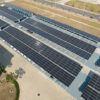
10–15kW Yard or Ground-Mounted System
For houses with sufficient outdoor space, a 10–15kW ground-mounted residential off-grid system can provide considerably more design flexibility.
Ground mounting removes some of the physical constraints associated with rooftops, although it introduces other considerations such as land availability, foundation, access, shading, wind exposure and permitting.
Ground-mounted PV systems can also use different mounting configurations and orientations depending on site conditions.
What Is a 10–15kW System Suitable For?
This system range may be considered when the objective is to support a larger share of a home’s essential loads, potentially including:
- Refrigeration
- Lighting
- Internet and communication equipment
- Entertainment systems
- Fans
- Computers
- Selected kitchen appliances
- Water pumps
- Other essential residential circuits
Whether it can support larger loads such as air conditioning, electric heating or electric water heating depends on the actual appliance ratings, operating schedule, inverter surge capacity, battery power and total daily energy requirement.
A 15kW PV array does not automatically mean that a home can continuously consume 15kW.
PV output changes with solar irradiance, temperature, orientation, shading and other conditions, while the inverter and battery impose their own power limits.
The Core Challenge: Residential Loads Are Highly Variable
One of the most important principles in residential off-grid solar system design is that household electricity demand is not constant.
At 10:00 AM, a home might only use:
- Refrigerator
- Router
- Lighting
- Laptop
At another moment, the same home could simultaneously start:
- Microwave
- Air conditioner
- Water pump
- Refrigerator compressor
The instantaneous demand can therefore be significantly higher than the home’s average consumption.
Continuous Power vs Surge Power
This is where inverter selection becomes critical.
An inverter needs to handle at least two different types of demand:
Continuous power:
The power required while appliances are operating normally.
Surge power:
The temporary additional power required when certain appliances or motors start.
For an off-grid system, the inverter therefore needs sufficient headroom for the expected operating scenario.
A simple example illustrates the concept:
Suppose a household has:
- 1.0kW of continuously operating loads
- 1.5kW microwave
- 1.0kW refrigerator and other intermittent loads
- An air conditioner with a higher startup demand
Selecting an inverter only from the average load could result in an undersized system.
The design should instead examine which loads can start at the same time and the manufacturer’s actual starting characteristics.
Why 2–3× Surge Assumptions Need Caution
It is common in off-grid discussions to use a simplified rule that some appliances may require roughly two or three times their running power during startup.
This can be useful as an initial warning, but it should not be treated as a universal engineering value.
Actual starting demand varies substantially by equipment.
For example, modern appliances with inverter-driven motors may behave differently from conventional induction-motor equipment. Soft-start systems and electronic controls can also change the startup profile.
For a professional project, the better approach is to obtain the appliance’s:
- Rated power
- Maximum input power
- Starting current
- Starting VA, where applicable
- Manufacturer specifications
Then size the inverter around the real load profile.
How to Match the Battery to the Inverter
An off-grid system does not only need enough solar generation. The battery must also deliver sufficient power when demand rises.
This creates an important relationship:
PV array → battery → inverter → household loads
If the battery has sufficient energy capacity but cannot provide the required instantaneous power, the system can still experience limitations.
Battery Energy Capacity
Battery capacity is normally discussed in kWh.
It determines how much energy can be stored and subsequently used, subject to usable capacity, depth of discharge, efficiency and operating conditions.
Battery Power Capability
Battery power is normally discussed in kW.
It determines how quickly the battery can deliver energy to the inverter.
These are different specifications.
A battery with a large kWh rating is not automatically suitable for a high-surge residential load if its discharge power is insufficient.
Comparing Balcony, Rooftop and Ground-Mounted Systems
The three scenarios can therefore be viewed as different combinations of space, load requirements and system complexity.
| Factor | 1–3kW Balcony | 3–10kW Rooftop | 10–15kW Ground Mount |
|---|---|---|---|
| Typical property | Apartment | Detached home | Home with yard |
| Main purpose | Essential loads | Household appliances | Broader essential-load coverage |
| Installation space | Very limited | Roof area | Ground area |
| Structural assessment | Balcony/building restrictions | Roof structure | Ground/foundation |
| Inverter consideration | Compact + adequate surge | Higher continuous/surge demand | Larger load headroom |
| Battery requirement | Essential-load backup | Extended household backup | Higher energy and power demand |
| Air conditioning | Usually difficult | Requires detailed sizing | More feasible with correct sizing |
| Battery environment | Compact installation | Dedicated/appropriate area | Dedicated battery area recommended |
| Design complexity | Lower | Medium | Higher |
The table should be treated as a planning framework, not a substitute for an engineering load calculation.
Battery Room Ventilation and Temperature Management
For larger residential systems, battery installation conditions become increasingly important.
A 10–15kW system may require a dedicated battery installation area rather than simply placing batteries wherever space is available.
The design should consider:
- Ambient temperature
- Ventilation requirements
- Battery manufacturer’s installation instructions
- Fire-safety requirements
- Access for inspection and maintenance
- Protection from water and direct weather exposure
- Clearance around equipment
The exact requirements depend on the battery chemistry, enclosure and applicable local codes.
This is another reason why a residential off-grid solar system should be treated as an integrated energy system rather than simply a collection of solar panels and batteries.
How Should a Homeowner Choose Between 1kW and 15kW?
Instead of starting with:
“How many kilowatts do I need?”
Start with:
“Which loads do I need to keep running, and when do they operate?”
A practical sizing sequence is:
Step 1: Define Essential Loads
Separate essential loads from non-essential loads.
For example:
Essential:
- Refrigerator
- Lighting
- Router
- Communications
- Selected fans
Optional:
- Large air conditioner
- Electric water heater
- Electric oven
- High-power tools
- EV charging
Step 2: Calculate Daily Energy Consumption
Estimate the energy required by each load:
Energy = Power × Operating Time
This gives a starting point for determining the PV and battery energy requirements.
Step 3: Identify Peak Simultaneous Loads
Determine which appliances may operate at the same time.
This is particularly important for:
- Air conditioners
- Refrigerators
- Pumps
- Microwave ovens
- Washing machines
- Compressors
- Power tools
Step 4: Check Startup Requirements
Use actual equipment specifications where possible instead of applying a universal multiplier.
Step 5: Size PV, Battery and Inverter as One System
A balanced system considers:
PV generation + battery energy + battery power + inverter continuous output + inverter surge capability
Changing one component may affect the appropriate sizing of the others.
What About Roof Orientation and Shading?
For rooftop systems, the physical installation site can be just as important as the nominal system size. Roof orientation, tilt, shading, available area, and structural condition all affect the practical design. DOE notes that PV mounting structures must provide adequate support and withstand environmental conditions, while orientation and tilt influence energy production.
This means a nominal 8kW system should not be treated as identical across every property.
Two homes with the same electricity demand may require different PV layouts because their roofs have different orientations or shading conditions.
A Better Way to Think About Residential Off-Grid Sizing
The most useful distinction is not simply:
1kW vs 5kW vs 10kW vs 15kW
It is:
Essential loads → daily energy → peak simultaneous demand → surge requirements → battery autonomy → PV production
This approach prevents a common sizing mistake: choosing the system based only on the total wattage printed on appliances.
For B2B energy solution providers, this also creates an opportunity to offer more meaningful customization. A residential project can be designed around the customer’s actual load profile instead of forcing every home into a standard configuration.
Key Takeaways
A 1–3kW balcony off-grid system is generally better suited to apartments and essential loads such as lighting, routers, and personal electronics.
A 3–10kW rooftop system provides more capacity for detached homes and common household appliances, but roof structure, orientation, shading, and appliance startup characteristics need to be evaluated.
A 10–15kW ground-mounted system can provide greater installation flexibility and support a broader set of residential loads when sufficient land is available, but battery installation, temperature management, ventilation, protection, and local requirements become increasingly important.
Most importantly, residential off-grid sizing is not just about average energy consumption. Household loads fluctuate, and appliances with motors or compressors can create short-duration power demands that are much higher than their normal operating consumption.
The right design therefore balances solar capacity, battery energy, battery power, inverter continuous output, and surge capability around the home’s actual operating pattern.
For customized residential energy projects, Huatao can further support system configuration based on installation scenario, load profile, PV capacity, and storage requirements. The technical priority should always be to match the system architecture to the home’s actual energy needs rather than selecting a nominal kW size in isolation.
Add comment