

An off-grid solar system is more than a group of solar panels connected to a battery. A reliable system depends on four core components working together: solar panels, a charge controller, a battery bank, and an inverter. The panels generate DC electricity, the controller manages how that energy reaches the batteries, the batteries store energy for later use, and the inverter converts DC power into usable AC electricity.
Understanding the role of each component is essential when designing an off-grid solar solution. A system with oversized panels but insufficient storage may struggle at night, while a large battery paired with an undersized solar array may not recover its energy efficiently. For B2B projects, the key is therefore not simply selecting four products, but matching the four components according to the load, climate, operating conditions, and required reliability.
What Are the Four Main Components of an Off-Grid Solar System?
The basic energy path can be understood as:
Sunlight → Solar Panels → Charge Controller → Battery → Inverter → AC Loads
Each component performs a different function.
| Component | Main Role | Key Selection Factors |
|---|---|---|
| Solar panels | Generate DC electricity | Power rating, efficiency, voltage, site conditions |
| Charge controller | Regulate PV-to-battery charging | MPPT/PWM, voltage, current, temperature compensation |
| Battery | Store electricity | Capacity, chemistry, usable energy, cycle life |
| Off-grid inverter | Convert DC to AC | Continuous power, surge power, output voltage, off-grid capability |
The system works properly only when these components are designed as an integrated system rather than independently selected products.
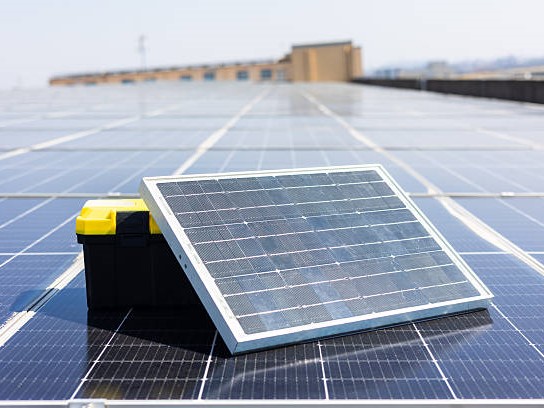
1. Solar Panels: The Power Generation Engine
Solar panels are the starting point of an off-grid solar system.
Photovoltaic modules convert sunlight into direct-current electricity. The amount of electricity available to the rest of the system depends on factors such as solar irradiance, module characteristics, temperature, orientation, shading, and array configuration. DOE notes that PV performance is affected by factors including temperature and the electrical characteristics of the cells and modules.
What Do Solar Panels Do in an Off-Grid System?
The basic function is simple:
Sunlight → Photovoltaic conversion → DC electricity
However, the design challenge is determining how much electricity the array needs to produce.
A system designer normally needs to consider:
- Daily energy consumption
- Peak load
- Local solar resource
- Seasonal variation
- Panel operating voltage
- Battery charging requirements
- Available installation area
- Expected system losses
For example, a remote monitoring station may have relatively low but continuous energy consumption, while an off-grid house may have high evening loads from lighting, refrigeration, pumps, and other appliances.
The required PV array should therefore be based on the actual load profile rather than simply selecting the largest available panel.
Why Panel Voltage Matters
Solar panels operate across a range of voltage and current conditions. Their output also changes with temperature and irradiance.
This becomes particularly important when selecting a charge controller because the controller must be compatible with the PV array’s operating and maximum voltage.
For larger off-grid installations, panel strings can be configured to achieve a suitable DC voltage before the power reaches the charge controller.
2. Charge Controller: The Energy Traffic Manager
The solar charge controller sits between the PV array and the battery bank.
Its main role is to regulate charging so that the battery receives appropriate voltage and current under different operating conditions.
A charge controller also helps prevent inappropriate charging conditions that could reduce battery performance or service life. Typical off-grid systems use either PWM or MPPT charge controllers.
What Does a Solar Charge Controller Control?
Depending on the system and controller design, it may manage:
- Charging voltage
- Charging current
- Battery charging stages
- Overcharge protection
- Low-voltage conditions
- Temperature compensation
- PV operating point
- Battery status and system monitoring
For installations exposed to large seasonal or daily temperature changes, temperature compensation can be an important consideration because battery charging requirements vary with temperature.
MPPT vs PWM: Why Does It Matter?
This is one of the most important choices in an off-grid solar system.
PWM Charge Controller
PWM stands for Pulse Width Modulation.
A PWM controller regulates the connection between the PV array and battery by rapidly switching the charging path. Its operating approach is relatively simple and can be suitable for smaller, cost-sensitive systems where panel and battery voltage are closely matched.
However, PWM does not actively search for the PV array’s maximum power point.
MPPT Charge Controller
MPPT stands for Maximum Power Point Tracking.
An MPPT controller continuously adjusts the operating point of the PV array to capture available power more effectively and converts the PV voltage/current combination to one suitable for battery charging.
This allows the PV array to operate at a voltage that can differ from the battery voltage, subject to the controller’s specifications.
The practical benefit is especially relevant when:
- PV voltage is significantly higher than battery voltage
- The array is relatively large
- Weather conditions vary substantially
- Cable runs are longer
- Maximizing available solar harvest is important
For this reason, MPPT is generally the more appropriate choice for many larger or performance-oriented off-grid systems, although the actual energy gain depends on the system configuration and operating conditions.

3. Battery: The Energy Storage Buffer
Solar panels generate electricity when sufficient sunlight is available. But an off-grid load does not necessarily consume electricity at the same time.
This makes the battery one of the most important components in an off-grid system.
DOE explains that batteries allow PV-generated energy to be stored for use at night or when weather conditions reduce sunlight reaching the panels.
Why Battery Capacity Determines Reliability
Consider a simple daily cycle:
Daytime → Solar generation + battery charging
Nighttime → Battery discharging + load supply
During cloudy periods, the battery may also need to compensate for reduced solar generation.
Therefore, insufficient battery capacity can cause the system to reach a low state of charge before solar generation resumes.
Battery sizing should consider:
- Daily energy consumption
- Required backup duration
- Depth of discharge
- Battery chemistry
- Temperature
- Charging and discharging efficiency
- Maximum continuous current
- Peak load requirements
- Expected cycle frequency
Energy Capacity Is Not the Same as Power Capacity
This distinction is particularly important for B2B system design.
A battery may have sufficient energy capacity in kWh but still be unsuitable if it cannot provide the required instantaneous power.
For example, a system may need to operate a pump or motor with a relatively high starting demand. The battery and inverter must both be capable of handling the associated power requirements.
This is why battery selection should not be based on kWh alone.
4. Off-Grid Inverter: From DC Storage to Usable AC Power
The off-grid inverter converts DC electricity from the battery and/or DC bus into AC electricity for compatible loads.
In a typical residential or commercial application, AC loads may include:
- Lighting
- Refrigerators
- Pumps
- Computers
- Communication equipment
- Air-conditioning equipment
- Small industrial equipment
DOE describes the fundamental function of an inverter as converting DC electricity into AC electricity. Advanced inverter systems can also incorporate additional control and communication functions.
Why an Off-Grid Inverter Is Different
A grid-tied inverter normally operates with reference to an existing utility grid.
An off-grid inverter, by contrast, must be capable of forming and maintaining its own AC output for the connected loads when no utility grid is available.
That means off-grid operation requires more than simply converting DC into AC.
The inverter needs to manage the relationship between:
Battery → Inverter → AC loads
while maintaining appropriate output voltage and frequency within its specified operating range.
Continuous Power vs Surge Power
When selecting an off-grid inverter, two power figures are particularly important.
Continuous power refers to the power the inverter can supply during normal operation.
Surge power refers to the temporary higher power that may be required when certain loads start.
Motors, compressors, pumps and other inductive loads can have significant starting demands. An inverter that looks adequate based only on continuous load may therefore be unsuitable for a system with high starting currents.
How Do the Four Components Work Together?
The four components form an energy conversion and storage chain.
Step 1: Solar Panels Generate DC Power
The PV array captures available sunlight and produces DC electricity.
Step 2: The Controller Regulates Charging
The charge controller determines how the available solar power is delivered to the battery.
With MPPT technology, the controller can track the PV array’s maximum power point to improve energy harvesting under changing operating conditions.
Step 3: The Battery Stores Energy
Excess available energy can be stored for periods when PV generation is insufficient.
Step 4: The Inverter Supplies AC Loads
When AC appliances require electricity, the inverter converts DC energy from the battery system into AC output.
The overall architecture can therefore be summarized as:
PV generation → Charge management → Energy storage → DC/AC conversion → Load
A weakness in any one stage can affect the performance of the complete system.
Why Component Matching Matters More Than Individual Specifications
One common mistake in off-grid system design is selecting each component independently.
For example:
“We need 10 kW of solar panels, a 20 kWh battery, and a 10 kW inverter.”
These numbers alone do not demonstrate that the system is correctly designed.
The components must be electrically and operationally compatible.
The PV Array Must Match the Controller
The controller must support the PV array’s maximum voltage and current.
The Controller Must Match the Battery
The charging profile, voltage range, and current capability must be compatible with the battery chemistry and configuration.
The Battery Must Match the Inverter
The battery needs to provide sufficient voltage, usable energy and discharge power for the inverter.
The Inverter Must Match the Load
The inverter needs sufficient continuous and surge capacity, as well as the correct AC output characteristics for the intended loads.
This is why an off-grid solar solution should be designed around the whole energy system, not four isolated product specifications.
How Climate Changes Component Selection
Climate is another variable that can easily be overlooked.
Hot Climates
High temperatures can affect PV performance and battery operating conditions. DOE notes that increasing PV cell temperature generally reduces voltage and can reduce module performance.
Battery thermal management and installation conditions should also be considered.
Cold Climates
Low temperatures can affect battery charging behavior, particularly for certain battery chemistries.
Temperature compensation and appropriate battery management become more important where daily and seasonal temperature changes are significant.
Cloudy or Seasonal Regions
If solar availability varies significantly throughout the year, the system may require:
- Larger PV capacity
- Greater battery autonomy
- More sophisticated energy management
- Backup generation in some applications
The right solution depends on the required reliability level rather than simply the average annual solar resource.
What Should B2B Buyers Consider When Specifying an Off-Grid System?
For a custom energy solution, buyers should provide more information than simply the desired solar capacity.
A professional system design should consider:
| Design Input | Why It Matters |
|---|---|
| Daily energy consumption | Determines required generation and storage |
| Peak load | Influences inverter and battery power |
| Load type | Motors and compressors may require surge capacity |
| Required backup duration | Determines battery energy capacity |
| Solar resource | Determines practical PV sizing |
| Ambient temperature | Influences PV and battery performance |
| Battery chemistry | Determines charging and operating requirements |
| AC output | Must match the intended loads |
| Installation environment | Affects enclosure, cooling, and protection |
| Future expansion | Determines whether components need additional capacity |
This information allows a supplier to move from product selection to actual system engineering.
Off-Grid Solar System: The Four Components Are a System, Not Four Separate Products
The four core components each have a clear role:
- Solar panels generate electricity.
- The charge controller regulates how solar energy charges the battery.
- The battery stores energy for periods of insufficient solar generation.
- The off-grid inverter converts and supplies usable AC power to loads.
But the real engineering challenge lies in how these components interact.
A high-quality off-grid system therefore starts with the load profile, climate, required autonomy and operating conditions, then works backward to select the appropriate PV array, MPPT controller, battery bank, and inverter.
For B2B projects, this component-matching approach is more valuable than simply combining standard products. It helps ensure that generation, storage, conversion and load requirements are balanced as one integrated energy solution.
Conclusion: Build the System Around the Energy Requirement
The “four big components” provide a simple way to understand an off-grid solar system, but reliable operation depends on more than knowing what each component does.
The solar panel determines how much energy can be generated. The controller determines how efficiently that energy can be managed. The battery determines how much energy can be carried through periods without sufficient sunlight. The inverter determines how effectively stored DC energy can be delivered as usable AC power.
For smaller systems, standard configurations may be sufficient. For larger residential, commercial, agricultural, or remote applications, component selection should be based on actual load, environmental conditions, autonomy requirements, and future expansion plans.
That is the difference between assembling four solar products and engineering a complete off-grid energy solution.
Add comment