

UN système solaire résidentiel hors réseau peut être très différent selon l'endroit où il est installé et ce dont le propriétaire a besoin pour l'alimenter. Un système compact de 1 à 3 kW sur le balcon d'un appartement est fondamentalement différent d'un système de toit de 3 à 10 kW ou d'un système au sol de 10 à 15 kW pour une maison avec cour..
La clé n’est pas simplement de choisir un panneau solaire plus grand. Un système hors réseau doit équilibrer production solaire, stockage de la batterie, capacité de l'onduleur, espace d'installation disponible, et les modèles de charge des ménages. La production solaire change également tout au long de la journée, tandis que la demande des ménages peut augmenter soudainement lorsque les appareils électroménagers démarrent.
Pour les projets résidentiels de 1kW à 15 kW, le scénario d'installation fournit un point de départ utile: systèmes de balcon pour charges essentielles, systèmes de toit pour les appareils électroménagers du quotidien, et systèmes montés au sol pour des charges résidentielles plus larges.
Système solaire résidentiel hors réseau: Trois scénarios typiques
Le cadre suivant peut aider les propriétaires et les développeurs de projets à comparer les trois options d'installation courantes..
| Scénario d'installation | Gamme de systèmes typique | Propriété appropriée | Charges typiques | Principal souci de conception |
|---|---|---|---|---|
| Balcon | 1-3kW | Appartement ou résidence compacte | Éclairage, routeur, téléphones, petit électronique | Espace et capacité de charge limités |
| Toit | 3–10 kW | Maison individuelle ou plus grande | Réfrigérateur, TV, les fans, éclairage, appareils électroménagers | État du toit, orientation et profil de charge |
| Montage sur cour/au sol | 10–15 kW | Maison avec terrain disponible | Charges de base pour toute la maison et gros appareils électroménagers | Atterrir, environnement de batterie et demande de pointe plus élevée |
Ces gammes sont catégories de planification plutôt que normes universelles. Le dimensionnement réel du système doit être basé sur la ressource solaire du site, zone d'installation utilisable, consommation d'énergie, autonomie souhaitée, et la demande en appareils électroménagers. Les directives du DOE recommandent également d'évaluer la demande énergétique et les caractéristiques spécifiques au site lors de la détermination de la taille du système photovoltaïque..
1–Système solaire hors réseau pour balcon de 3 kW
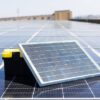
UN 1–Système solaire résidentiel hors réseau de 3 kW est généralement l'option la plus soucieuse de l'espace dans cette comparaison.
Cela peut être pertinent pour les utilisateurs d'appartements, maisons compactes, petits espaces auxiliaires, ou des situations où seules les charges essentielles nécessitent une alimentation de secours.
Que peut alimenter un système de balcon?
L'objectif pratique est généralement couverture des charges essentielles, plutôt que d'essayer de gérer un appartement entier de manière indépendante.
Les charges typiques peuvent inclure:
- Éclairage LED
- Routeurs Wi-Fi
- Smartphones et tablettes
- Ordinateurs portables
- Petit électronique
- Matériel de communication
- Appareils sélectionnés à faible consommation
Un système de batterie correctement conçu peut stocker l’énergie solaire pour l’utiliser lorsque la lumière du soleil n’est pas disponible.. Energy storage is particularly important for off-grid operation because PV generation does not necessarily coincide with the time electricity is needed.
Microinverter or Small Off-Grid Inverter?
Microinverters are widely used in PV systems because they convert the DC output of individual modules into AC and can provide independent module-level operation.
Cependant, un true off-grid residential system also needs to be designed around battery storage and an inverter architecture capable of maintaining the required standalone AC supply.
Donc, buyers should not select an inverter simply because its nominal power matches the PV array.
The more important questions are:
- What loads must operate simultaneously?
- What is the battery voltage?
- What is the required continuous AC output?
- What is the inverter’s surge capability?
- How long should essential loads operate without solar generation?
Best Use Case for Balcony Systems
A balcony system makes more sense when the goal is:
“Keep essential electronics and basic lighting running.”
It becomes less suitable when the requirement changes to:
“Run high-power household appliances simultaneously.”
That distinction is critical when designing a small off-grid system.
3–10kW Rooftop Off-Grid Solar System
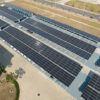
UN 3–10kW rooftop solar system is more suitable for detached homes with sufficient roof area and a broader range of household loads.
The available roof area, orientation, ombres, structural condition and local solar resource all affect system design. DOE guidance specifically recommends evaluating roof suitability and structural considerations before installing rooftop solar.
What Can a 3–10kW System Support?
Depending on the actual system configuration and battery capacity, a rooftop off-grid system can be designed to support loads such as:
- Réfrigérateur
- Television
- Fans
- Éclairage LED
- Internet equipment
- Ordinateurs
- Small kitchen appliances
- Other selected household loads
Cependant, PV capacity alone does not determine whether an appliance can start.
This is especially important for refrigerators, pompes, air conditioners and other motor-driven equipment.
Why Air Conditioning Needs Separate Calculation
Air conditioning deserves special attention because its electrical demand is not necessarily represented by its steady operating consumption alone.
When a compressor or motor starts, the system may experience a short-duration increase in electrical demand. The exact starting characteristics depend on the appliance design, motor technology, controls and manufacturer specifications.
Donc, an off-grid system intended to support air conditioning should evaluate:
running power + starting demand + other simultaneous loads
rather than simply adding the air conditioner’s nameplate running wattage to the total.
DOE guidance also emphasizes using the equipment’s actual nameplate information when sizing electrical components for air-conditioning circuits rather than relying on simplified assumptions.
10–15kW Yard or Ground-Mounted System
For houses with sufficient outdoor space, un 10–15kW ground-mounted residential off-grid system can provide considerably more design flexibility.
Ground mounting removes some of the physical constraints associated with rooftops, although it introduces other considerations such as land availability, foundation, access, ombres, wind exposure and permitting.
Ground-mounted PV systems can also use different mounting configurations and orientations depending on site conditions.
What Is a 10–15kW System Suitable For?
This system range may be considered when the objective is to support a larger share of a home’s essential loads, potentially including:
- Réfrigération
- Éclairage
- Internet and communication equipment
- Entertainment systems
- Fans
- Ordinateurs
- Selected kitchen appliances
- Pompes à eau
- Other essential residential circuits
Whether it can support larger loads such as air conditioning, electric heating or electric water heating depends on the actual appliance ratings, horaire d'exploitation, inverter surge capacity, battery power and total daily energy requirement.
A 15kW PV array does not automatically mean that a home can continuously consume 15kW.
PV output changes with solar irradiance, température, orientation, shading and other conditions, while the inverter and battery impose their own power limits.
The Core Challenge: Residential Loads Are Highly Variable
One of the most important principles in residential off-grid solar system design is that household electricity demand is not constant.
À 10:00 SUIS, a home might only use:
- Réfrigérateur
- Router
- Éclairage
- Laptop
At another moment, the same home could simultaneously start:
- Microwave
- Air conditioner
- Pompe à eau
- Refrigerator compressor
The instantaneous demand can therefore be significantly higher than the home’s average consumption.
Puissance continue vs puissance de surtension
This is where inverter selection becomes critical.
An inverter needs to handle at least two different types of demand:
Puissance continue:
The power required while appliances are operating normally.
Surtension:
The temporary additional power required when certain appliances or motors start.
For an off-grid system, the inverter therefore needs sufficient headroom for the expected operating scenario.
A simple example illustrates the concept:
Suppose a household has:
- 1.0kW of continuously operating loads
- 1.5kW microwave
- 1.0kW refrigerator and other intermittent loads
- An air conditioner with a higher startup demand
Selecting an inverter only from the average load could result in an undersized system.
The design should instead examine which loads can start at the same time and the manufacturer’s actual starting characteristics.
Why 2–3× Surge Assumptions Need Caution
It is common in off-grid discussions to use a simplified rule that some appliances may require roughly two or three times their running power during startup.
This can be useful as an initial warning, but it should not be treated as a universal engineering value.
Actual starting demand varies substantially by equipment.
Par exemple, modern appliances with inverter-driven motors may behave differently from conventional induction-motor equipment. Soft-start systems and electronic controls can also change the startup profile.
For a professional project, the better approach is to obtain the appliance’s:
- Puissance nominale
- Maximum input power
- Courant de démarrage
- Starting VA, where applicable
- Manufacturer specifications
Then size the inverter around the real load profile.
How to Match the Battery to the Inverter
An off-grid system does not only need enough solar generation. The battery must also deliver sufficient power when demand rises.
This creates an important relationship:
PV array → battery → inverter → household loads
If the battery has sufficient energy capacity but cannot provide the required instantaneous power, the system can still experience limitations.
Battery Energy Capacity
Battery capacity is normally discussed in kWh.
It determines how much energy can be stored and subsequently used, subject to usable capacity, profondeur de décharge, efficiency and operating conditions.
Battery Power Capability
Battery power is normally discussed in kW.
It determines how quickly the battery can deliver energy to the inverter.
These are different specifications.
A battery with a large kWh rating is not automatically suitable for a high-surge residential load if its discharge power is insufficient.
Comparing Balcony, Rooftop and Ground-Mounted Systems
The three scenarios can therefore be viewed as different combinations of space, load requirements and system complexity.
| Factor | 1–3kW Balcony | 3–10kW Rooftop | 10–15kW Ground Mount |
|---|---|---|---|
| Typical property | Apartment | Detached home | Home with yard |
| Main purpose | Essential loads | Household appliances | Broader essential-load coverage |
| Installation space | Very limited | Roof area | Ground area |
| Structural assessment | Balcony/building restrictions | Roof structure | Ground/foundation |
| Inverter consideration | Compact + adequate surge | Higher continuous/surge demand | Larger load headroom |
| Battery requirement | Essential-load backup | Extended household backup | Higher energy and power demand |
| Climatisation | Usually difficult | Requires detailed sizing | More feasible with correct sizing |
| Battery environment | Compact installation | Dedicated/appropriate area | Dedicated battery area recommended |
| Design complexity | Inférieur | Moyen | Higher |
The table should be treated as a planning framework, not a substitute for an engineering load calculation.
Battery Room Ventilation and Temperature Management
For larger residential systems, battery installation conditions become increasingly important.
A 10–15kW system may require a dedicated battery installation area rather than simply placing batteries wherever space is available.
The design should consider:
- Température ambiante
- Ventilation requirements
- Battery manufacturer’s installation instructions
- Fire-safety requirements
- Access for inspection and maintenance
- Protection from water and direct weather exposure
- Clearance around equipment
The exact requirements depend on the battery chemistry, enclosure and applicable local codes.
This is another reason why a système solaire résidentiel hors réseau should be treated as an integrated energy system rather than simply a collection of solar panels and batteries.
How Should a Homeowner Choose Between 1kW and 15kW?
Instead of starting with:
“How many kilowatts do I need?”
Start with:
“Which loads do I need to keep running, and when do they operate?”
A practical sizing sequence is:
Étape 1: Define Essential Loads
Separate essential loads from non-essential loads.
Par exemple:
Essential:
- Réfrigérateur
- Éclairage
- Router
- Communications
- Selected fans
Facultatif:
- Large air conditioner
- Electric water heater
- Electric oven
- High-power tools
- EV charging
Étape 2: Calculer la consommation d'énergie quotidienne
Estimate the energy required by each load:
Energy = Power × Operating Time
This gives a starting point for determining the PV and battery energy requirements.
Étape 3: Identify Peak Simultaneous Loads
Determine which appliances may operate at the same time.
This is particularly important for:
- Air conditioners
- Réfrigérateurs
- Pompes
- Microwave ovens
- Washing machines
- Compressors
- Power tools
Étape 4: Check Startup Requirements
Use actual equipment specifications where possible instead of applying a universal multiplier.
Étape 5: Size PV, Battery and Inverter as One System
A balanced system considers:
PV generation + énergie de la batterie + puissance de la batterie + inverter continuous output + inverter surge capability
Changing one component may affect the appropriate sizing of the others.
What About Roof Orientation and Shading?
For rooftop systems, the physical installation site can be just as important as the nominal system size. Roof orientation, tilt, ombres, available area, and structural condition all affect the practical design. DOE notes that PV mounting structures must provide adequate support and withstand environmental conditions, while orientation and tilt influence energy production.
This means a nominal 8kW system should not be treated as identical across every property.
Deux maisons ayant la même demande en électricité peuvent nécessiter des configurations photovoltaïques différentes car leurs toits ont des orientations ou des conditions d'ombrage différentes..
Une meilleure façon de penser au dimensionnement résidentiel hors réseau
La distinction la plus utile n'est pas simplement:
1kW contre 5 kW contre 10 kW contre 15 kW
C'est:
Charges essentielles → énergie quotidienne → demande simultanée de pointe → besoins en surtension → autonomie de la batterie → production photovoltaïque
Cette approche évite une erreur de dimensionnement courante: choisir le système en fonction uniquement de la puissance totale imprimée sur les appareils.
Pour les fournisseurs de solutions énergétiques B2B, cela crée également une opportunité d'offrir une personnalisation plus significative. Un projet résidentiel peut être conçu en fonction du profil de charge réel du client au lieu de forcer chaque maison à adopter une configuration standard..
Points clés à retenir
UN 1–Système hors réseau pour balcon de 3 kW est généralement mieux adapté aux appartements et aux charges essentielles telles que l’éclairage, routeurs, et appareils électroniques personnels.
UN 3–Système de toit de 10 kW offre plus de capacité pour les maisons individuelles et les appareils électroménagers courants, mais la structure du toit, orientation, ombres, et les caractéristiques de démarrage de l'appareil doivent être évaluées.
UN 10–Système au sol de 15 kW peut offrir une plus grande flexibilité d’installation et prendre en charge un ensemble plus large de charges résidentielles lorsque suffisamment de terrain est disponible, mais installation de la batterie, gestion de la température, ventilation, protection, et les exigences locales deviennent de plus en plus importantes.
Le plus important, Le dimensionnement des logements résidentiels hors réseau n’est pas seulement une question de consommation énergétique moyenne.. Les charges des ménages fluctuent, et les appareils équipés de moteurs ou de compresseurs peuvent créer des demandes d'énergie de courte durée bien supérieures à leur consommation de fonctionnement normale..
La bonne conception équilibre donc capacité solaire, énergie de la batterie, puissance de la batterie, inverter continuous output, et capacité de surtension autour du mode de fonctionnement réel de la maison.
Pour des projets énergétiques résidentiels personnalisés, Huatao peut également prendre en charge la configuration du système en fonction du scénario d'installation, profil de charge, Capacité photovoltaïque, et les exigences de stockage. La priorité technique doit toujours être d’adapter l’architecture du système aux besoins énergétiques réels de la maison plutôt que de sélectionner isolément une puissance nominale en kW..
Ajouter un commentaire